“Plans are nothing, but planning is everything.” – Dwight D. Eisenhower
“By failing to prepare, you are preparing to fail.” – Benjamin Franklin
Introduction: Four Common Tools to plan your life, but which one is right for you?
Those of you who have been following my blog for a while know that at Life Organised, we believe in the benefits of planning your life to have more time for what truly matters and move the needle forward on your goals.
But with a plethora of planning tools available, it is hard to know which to use. There is no one-size-fits-all and no right or wrong tool. In the blog post below, I want to introduce the reader to four common planning tools so they can assess which one is right for them.
The Bullet Journal
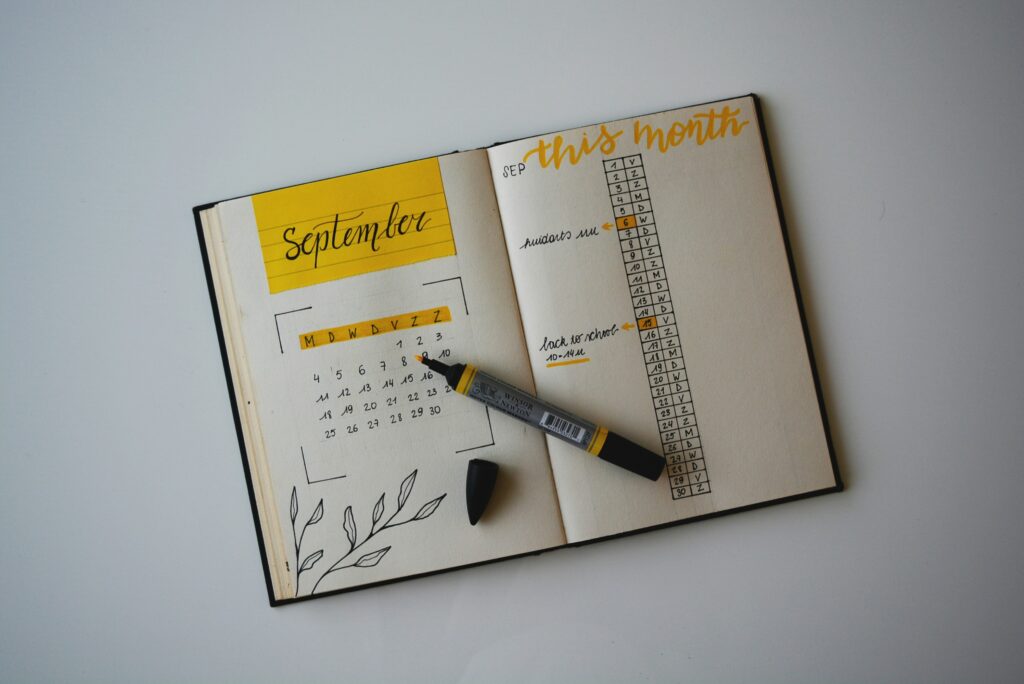
The Bullet Journal Method, or Brujo for short, is an analogue productivity method where people keep track of their tasks, appointments, reading lists, thoughts and feelings in a simple notebook, often a gridded or blank one:
‘A bullet journal (sometimes known as a BuJo) is a method of personal organization developed by designer Ryder Carroll. The system organizes scheduling, reminders, to-do lists, brainstorming, and other organizational tasks into a single notebook.’ (Wikipedia)
Vienna-born Ryder Carroll was diagnosed with ADHD and struggled to complete tasks at a young age. After graduating from college in the US, he got a job as a Digital product designer in New York. While working, he devised the bullet journal method to help him focus on multiple tasks simultaneously. Carroll describes his journey toward creating the bullet journal in more detail in his book The Bullet Journal Method: Track the Past, Order the Present, Design the Future, published in 2018.
As with every productivity system, there are pros and cons. Below, I will briefly outline the pros and cons of bullet journaling.
Numerous studies have shown the benefits of writing in longhand rather than typing. It makes us slow down and take more care with our writing. It also makes us more concise as the process takes longer than typing. Further writing in longhand enables us to retain more of what we write. According to Craft your content:
‘Writing by hand is much more prolonged, requiring us to be somewhat choosy in what we jot down. This results in us having to mentally put in more effort to write; our brains function more intensely, which results in a better quality of work.
It’s a workout for your brain, ultimately, in the sense that you’re using it a lot more while writing at a much slower pace than you would typing.’
Another benefit of the bullet journal, compared to digital to-do lists or pre-printed planners, is the ability to customise your pages fully. However advanced many of the to-do list apps have become, no app can give you things just so. On the other hand, a bullet journal allows you to create any spread in any way you like.
Bullet Journals also have no sync issues or technological breakdowns that can occur with anything electronic.
On the other hand, writing things out in longhand can be time-consuming and frustrating and requires a lot of duplication. For example, in a to-do app, you put in ‘Feed cat daily’, and it will automatically appear in your daily list. However, you must write it out in a manual journal seven times each week. Drawing out each spread, whether you keep an artistic spread or just a functional one, takes forever.
Further, there are no backups for bullet journals, so if you lose them, you are stuffed.
Whether the Bullet Journal is right or wrong for you is for you to decide. However, I think it suits creative people who enjoy drawing on paper. It is also suitable for people who are less into technology and prefer a paper-based option. Finally, people who are trying to cut down on screen time would also benefit from it.
I have written in more detail about the Bullet Journal Method here.
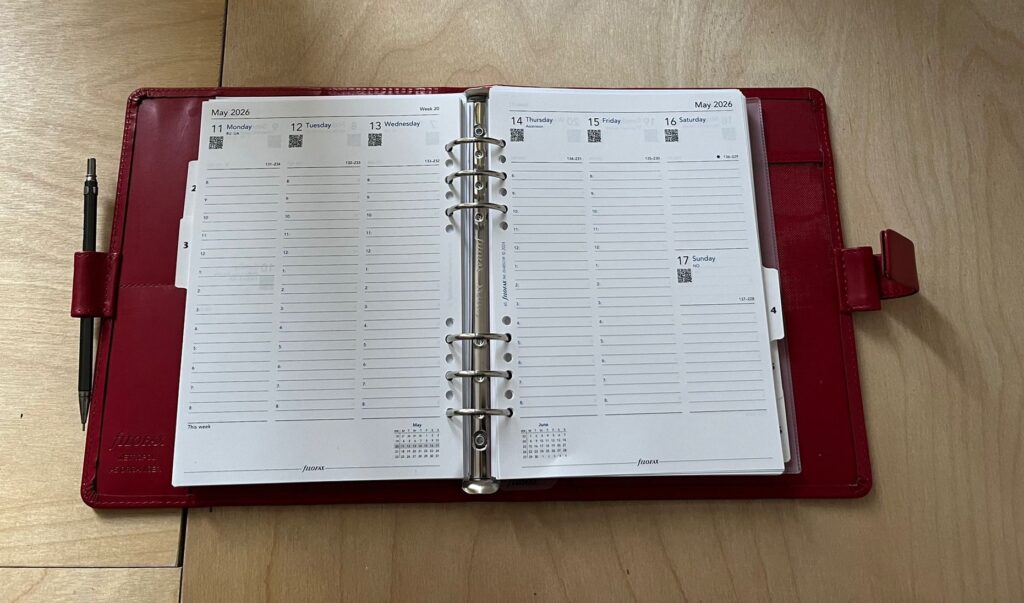
Filofax and other ring-bound planners
Filofax has become an icon in the world of personal organisation—a name that evokes craftsmanship, customisation, and a distinctly tactile approach to planning. Founded in the early 20th century, Filofax began as a simple loose-leaf notebook system and evolved into a global symbol of productivity, especially popular in the 1980s and 1990s. Today, it retains a loyal following among planner enthusiasts who value both its heritage and its flexibility.
At the heart of Filofax’s appeal is its modular design. Users can choose from a wide range of binder styles—classic leather, contemporary fabrics, minimalist finishes—and then fill them with the inserts that suit their needs. Calendars, to-do lists, finance trackers, project pages, dividers, and notebooks can all be arranged and rearranged endlessly. This adaptability makes a Filofax feel less like a planner and more like a personalised command centre. Filofaxes also come in a host of sizes from Mini to A4.
The tactile experience is equally important. Turning metal rings, snapping pages into place, or writing on high-quality paper creates a sense of intentionality that digital tools often lack. Many users treat their Filofax as both a practical planner and a creative outlet, adding custom inserts, decorative elements, or even using it as a hybrid planner-journal.
Filofax also stands out for its durability. A well-cared-for binder can last for years, with only the inserts needing replacement. This makes it not just an organisational tool but an investment—one that evolves with changing goals, jobs, and lifestyles.
In an era filled with productivity apps and cloud-based calendars, Filofax continues to thrive because it offers something different: a customisable, enduring, and deeply personal way to stay organised. For anyone who values both structure and creativity, a Filofax can be a timeless companion.
The Filofax is a very versatile productivity system that suits anyone who desires flexibility without the hassle of a Bullet Journal, where you have to hand-draw each spread. But the Filofax might also be overwhelming to some people, as you can literally insert hundreds of different layouts.
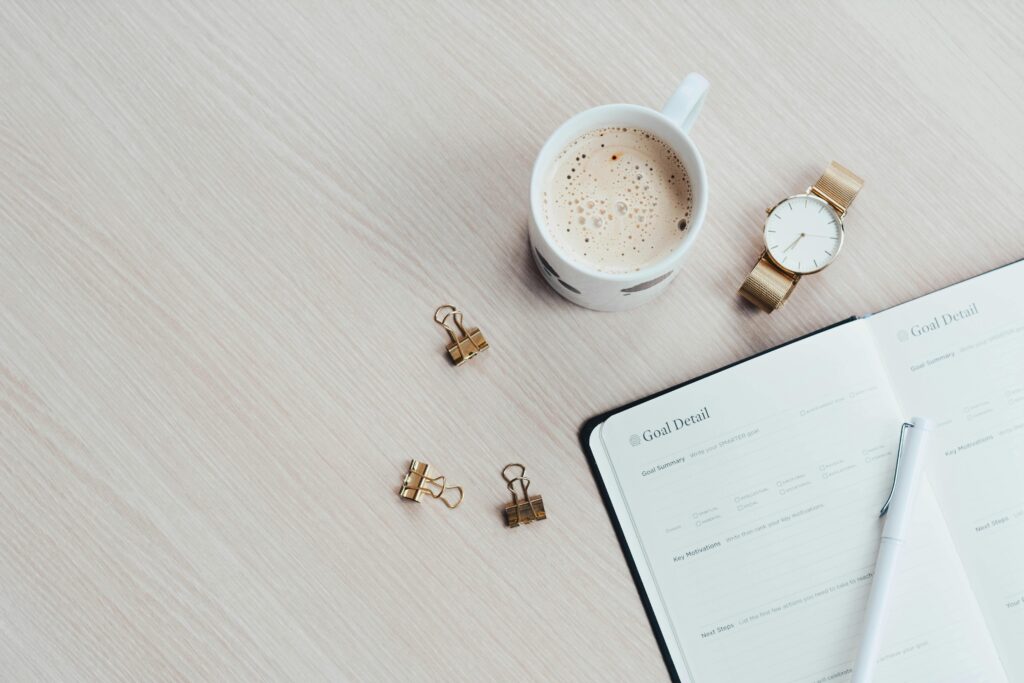
Paper Planers
Paper planners are enjoying a resurgence in a world dominated by digital apps and always-on devices. While smartphones offer convenience, many people find that writing plans by hand provides a sense of clarity and calm that screens can’t match.
One of the most significant benefits of a paper planner is its ability to reduce digital distraction. There are no pop-up alerts, no multitasking temptations—just a clean space to focus on what matters. The physical act of writing also helps reinforce memory, making appointments and goals easier to recall.
Paper planners encourage intentionality. Turning a page, mapping out a week, or crossing off a completed task creates a tangible connection to your time. Many users enjoy customising layouts with colour coding, stickers, or notes, turning planning into a creative ritual rather than a chore.
Beyond organisation, planners can act as companions for reflection. Sections for daily gratitude, habit tracking, or brief journaling offer opportunities to slow down and check in with yourself.
In a fast-paced digital era, paper planners provide something refreshingly simple: a quiet space to think, plan, and stay grounded.
There are literally hundreds of different planners out there. Hobonichi, Happy Planner or Kokuyo Jibun Techo, to name just three of the most common ones, come in a plethora of sizes and layouts. Horizontal, Vertical, Weekly, Monthly or daily are common layouts.
These planners benefit from their compactness and very structured nature. The downside is that you can’t change their layout or add pages.
Digital Calendars and Todo List Apps
In an increasingly connected world, digital calendars and to-do list Apps have become indispensable tools for organising personal and professional life. Whether built into smartphones, synced across cloud platforms, or integrated into workplace productivity systems, they offer a streamlined way to manage appointments, deadlines, and daily routines. Yet, like any tool, digital calendars come with both strengths and limitations. Understanding these can help individuals choose the planning method that best supports their lifestyle.
One of the most significant benefits of digital calendars is their flexibility. They can be accessed from virtually any device—phone, laptop, tablet, or smartwatch—allowing users to check schedules or make updates instantly. This portability makes it easier than ever to stay organised while travelling or working remotely.
Digital calendars reduce much of the mental load of remembering appointments. Built-in reminders help ensure that critical events, deadlines, and recurring commitments aren’t overlooked. Alerts can be customised to appear minutes, hours, or even days in advance.
Plans change, and digital calendars adapt quickly. With a few taps, users can reschedule appointments, colour-code events, add notes, or reorganise their day. This ease of editing makes it simple to manage complex schedules without the messiness of crossing out or rewriting entries.
Modern digital calendars connect with email platforms, video-conferencing apps, task managers, and voice assistants. This integration automatically creates events from emails, syncs reminders across devices, and lets meetings include links or attachments—all without manual input.
Digital calendars are especially powerful in shared environments. Families can track essential events together, while coworkers can coordinate meetings by viewing mutual availability. Shared access reduces scheduling conflicts and improves communication.
Of course, there are drawbacks as well. Digital calendars require functioning devices, battery power, and sometimes internet access. A dead phone, app glitch, or sync error can temporarily lock users out of their schedule, which can be stressful during time-sensitive moments.
While reminders can be helpful, too many notifications may become overwhelming. Users can quickly become desensitised, leading to ignored alerts—or, worse, missed appointments.
Checking a digital calendar often means opening a device that contains social media, messages, and other distractions. For those trying to reduce screen time, this can be counterproductive.
Some calendar apps offer so many features—multiple calendars, integrations, settings, and views—that new users may find them intimidating. The time required to set up or maintain a digital system can be a drawback for those seeking simplicity.
Digital calendars bring efficiency, connectivity, and convenience to daily life, but they are not a perfect solution for everyone. Some people thrive when their schedule is visually displayed and easily edited on a screen; others prefer the tactile experience and simplicity of traditional paper planners. For many, the ideal approach is a hybrid—one that uses a digital calendar for appointments and reminders while relying on paper for long-term planning or reflective journaling.
Ultimately, the best calendar is the one that supports your goals, fits your habits, and reduces the mental load of time management. Digital calendars offer powerful tools to make that happen, as long as users remain mindful of their limitations.
trabantbettina

Bettina Anna Trabant, Founder of Life Organised, your professional organising and decluttering service in East London. Eco-conscious minimalist and avid tea drinker,